Did your operators communicate with customers appropriately?
Customer service managers need to answer this question every day to maintain service standards. However, finding the answer often requires listening to dozens or even hundreds of calls. It is simply not possible for a person to review every call individually. That is why call centers are beginning to use AI for quality assurance.
Previously, managers could only review a small sample of calls. With AI, every call can be evaluated against the standards established by the organization, enabling more comprehensive and consistent quality monitoring.

1. Regularly evaluates every call
AI evaluates operator performance based on your organization’s service standards and requirements, helping identify mistakes and areas for improvement quickly. This makes it easier to determine which employees need additional training and continuously improve service quality.
For example, an organization may evaluate operators against the following criteria:
- Did the operator greet the customer appropriately?
- Did they correctly understand the customer’s issue?
- Did they provide accurate and complete information?
- Did they use the required service phrases?
- Did they answer the customer’s questions clearly?
- Was their tone and attitude appropriate?
- Did they communicate all necessary information and reminders?
- Did they resolve the customer’s issue?
- Did they close the call correctly?
One operator may communicate politely but struggle to resolve customer issues. Another may resolve issues quickly but lack a friendly tone. The key benefit of quality evaluation is being able to identify what each operator does well and where improvement is needed.
In other words, AI helps identify each operator’s strengths and weaknesses. Managers can assess how well each call meets service standards based on actual performance data for individual employees.
2. Identifies mistakes and shortcomings in a timely manner
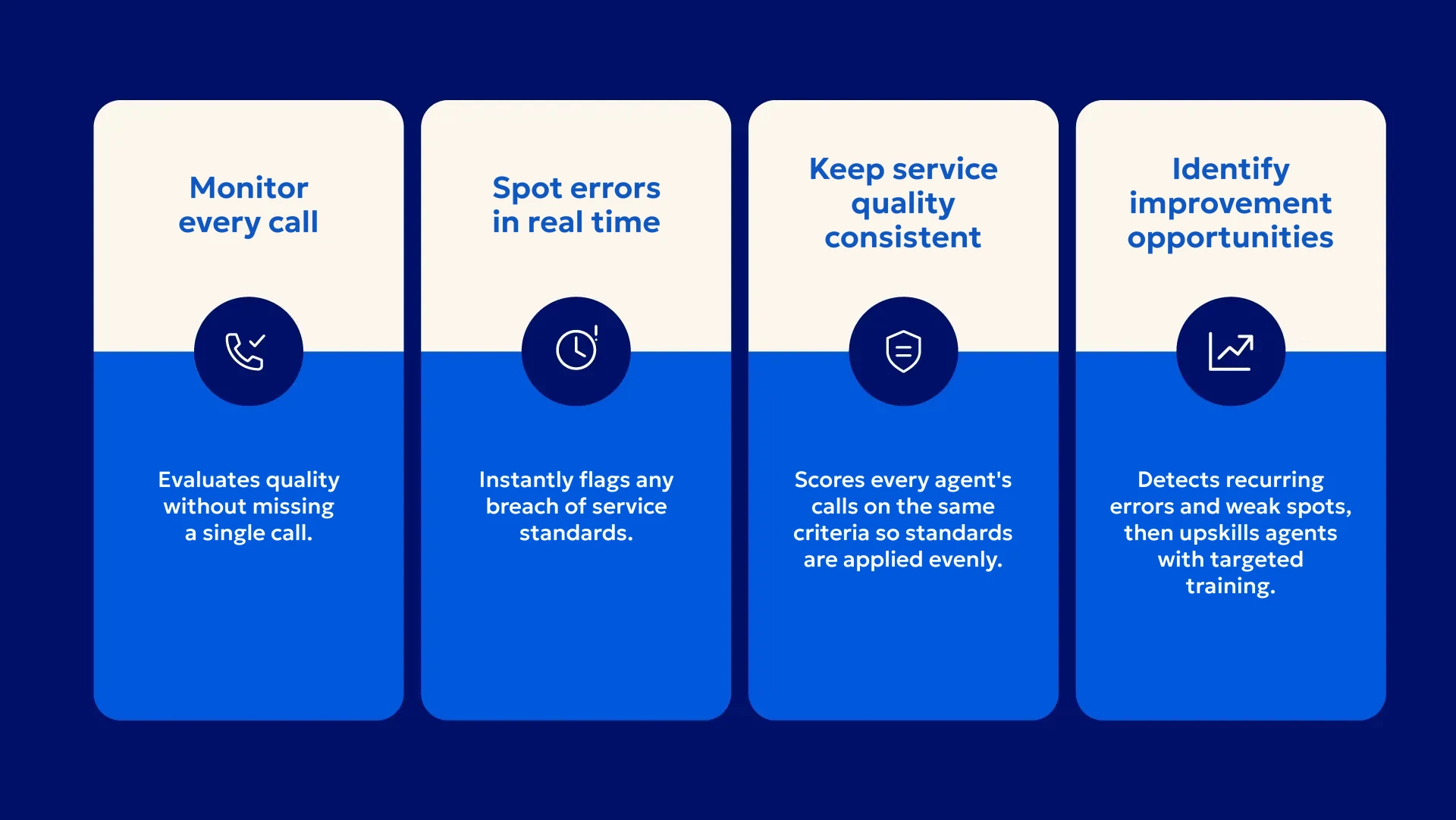
There is no need to spend the entire day listening to every call and manually evaluating operator performance. AI automatically reviews all calls and flags those with issues or those requiring additional attention. This allows managers to focus their analysis on the calls that need it most, saving time and using it more effectively.
When mistakes are only discovered at the end of the month, operators may no longer remember the specific calls or circumstances involved. By identifying errors shortly after a call and addressing them promptly, organizations can improve service quality more effectively.
This also makes it possible to identify issues related to operator communication, attitude, and service quality, as well as customer complaints and areas for improvement, without waiting days or months for the information.
3. Establishes Consistent Service Standards
When customers call an organization, each operator may respond with a different tone and approach, which can affect service quality. Consistently applying the organization’s service standards across all calls is key to delivering a reliable, high-quality experience to every customer.
An AI assistant evaluates every call against predefined criteria, providing a clear picture of how consistently service standards are being followed.
This enables organizations to monitor and improve service quality across the entire team, rather than relying solely on each operator’s individual experience and approach.
Leave your details in the form below to receive free advice and information from our specialists on improving your call quality assurance.